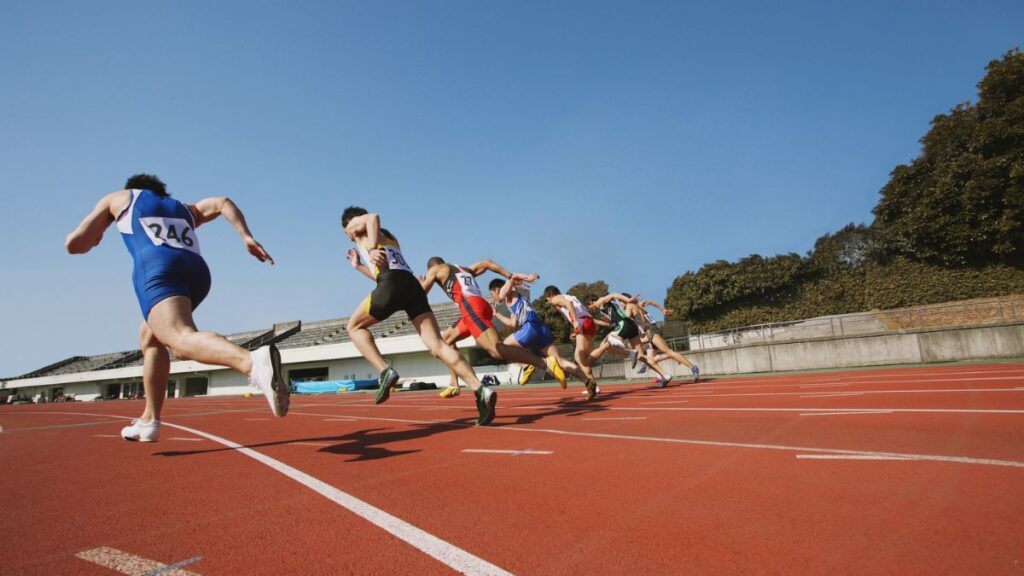
A synthetic running track is a layered system, and every layer is only as good as the process that put it down. Binder and granulate have to be blended at the same ratio from the first batch to the last, thickness has to hold across the straights and the curves, coating texture has to be even, and line marking has to meet the standard the facility is certified against. Those are repeatability problems, and repeatability is what machinery buys you.
SMG builds equipment for each phase of that process. Here is how the lineup breaks down.
Mixing: where consistency is won or lost
The MixMatic M6004 is the production machine in the range. It is a fully automatic continuous mixer for rubber granulate and single-component polyurethane binder, rated at 150 kg per minute, and it can be connected to additional components such as a gravel unit or a second PU pump. That flexibility is what makes it relevant across recycled granulate base mats, EPDM surfaces, sandwich systems, PUR coatings, and elastic subbases. A shared control panel for the mixer and auxiliary units keeps operation manageable when several components are running at once.
Best fit: full track installations, elastic subbases, multi-layer systems.
The MixMatic M140 solves a different problem. It is a compact batch mixer with an electric drive running at 50 rpm, producing homogeneous results in under two minutes. The open drum gives the operator eyes on the mix throughout, and a filling grid with integrated safety shut-off allows components to be added mid-cycle. Filling height adjusts between 1,053 mm and 1,353 mm, and pneumatic wheels with quick-release fasteners plus a foldable towing handle mean it can be repositioned by hand without tools. It is matched to small pavers up to 1.5 m working width, including the P208, P211, and P215.
Best fit: small and medium batches, detail work, tight sites.
Paving: width, thickness, and curve control
The PlanoMatic P936 is the largest fully automatic paver in the group, installing up to 3,600 mm wide with theoretical area performance up to 970 m² per hour. Paving thickness adjusts from 0 to 50 mm, and it includes automatic curve control for track geometry plus a hydraulic undercarriage. An optional leveling device is available. This is a productivity machine, and its footprint reflects that.
Best fit: large-scale track and surface installations.
The PlanoMatic P928 covers the same functional ground at up to 2,700 mm width and roughly 730 m² per hour. It carries the same automatic curve control and 0 to 50 mm thickness adjustment from the control panel. For a standard school or municipal athletic facility, the P928 usually delivers enough output without the maneuvering demands of the P936.
Best fit: school, municipal, and multipurpose athletic surfaces.
The PlanoMatic P703 is the specialist. Installation width is approximately 2,700 mm at around 730 m² per hour, but the differentiator is control rather than throughput. A narrower chain drive unit, automatic leveling, adjustable screed oscillation speed, and material limiters all serve edge precision, and control panels on both sides let the operator work from whichever position the geometry demands.
Best fit: professional running track installation where edges and surface consistency matter most.
Finishing: texture, coverage, and lines
The StrukturMatic S122D applies structural spray coatings and primers, handling solvent-based, solvent-free, and water-based PU dispersions at a 15 kg per minute spray rate. It is designed to move thick, coarse-grained material without losing an even finish, and adjustable pump pressure and air volume give the operator control over vapor and application quality. Coating is not cosmetic on a track. It determines grip and texture.
The GranuMatic G402D takes one of the most labor-intensive steps in the process and makes it measurable. It broadcasts rubber granules onto polyurethane coatings across a radius up to 12 m, delivering roughly 50 to 75 kg per minute depending on granulate spec. Hand broadcasting varies by operator and by hour. This does not.
The LineStar LS15 handles striping, with a compressor and petrol engine driving line widths from 4 to 15 cm and controls mounted at the handlebars. Solid-rubber tires with precision bearings keep it tracking smoothly, which matters when national and international marking standards apply.
Renewal: milling, cutting, cleaning
Resurfacing is often the better economic call when the underlying structure is sound, and SMG covers that path.
The RauMatic R400D mills coatings off elastic PU surfaces to a maximum depth of 10 mm, with a 400 mm working width and up to 440 m² per hour at 4 mm depth. The manually operated RauMatic R125 is the precision counterpart, with nine individual milling discs configurable in 15 mm increments from 15 mm to 135 mm. Milling depth is infinitely variable from 0 to 5 mm across the full width, and running a single disc allows cuts up to 17 mm. It works right up to the curb stone.
The TrackCutter TC400 sections worn surfaces into manageable plates or strips, typically around 1 m by 1 m, with cutting depth adjustable from 0 to 15 mm. It is particularly useful near curbs, drains, and edges where clean cuts speed up removal.
The WashMatic WM800 is a ride-on cleaner using high-pressure water up to 140 bar, with eight rotating nozzles on the front attachment that suction away dirty water and organic contamination. Working width is 800 mm at roughly 200 to 250 m² per hour.
The verdict
The lineup is coherent rather than sprawling. Each stage has a high-output option and a precision option, and the pairings are deliberate, as with the M140 matched to pavers up to 1.5 m. For contractors, the practical question is less about which machine is best and more about which combination matches typical project scale. A crew running full 400 m installs will build around the M6004 and a P936 or P703. A crew doing more renovation than new construction will get more out of the milling and cutting side of the catalog.